
The MGC homeowner & business guide / Interior painting
Choosing Interior Paint Colors: Working with Your Existing Floors and Trim
Choose wall colors in the context of the finishes you are keeping.
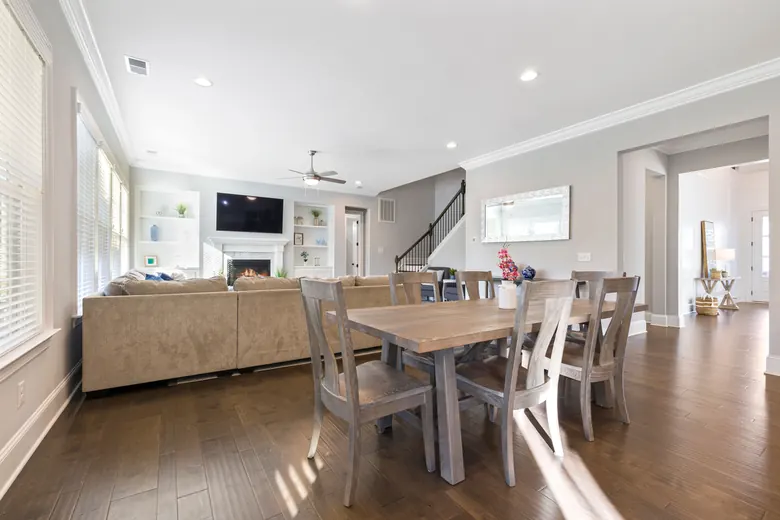
A paint color can look appealing on a small card and feel quite different beside your living room floor. The reason is context: walls are seen together with wood, tile, trim, furnishings, and changing light.
When you are choosing interior paint colors, begin with the parts of the room that will stay. That gives you a useful starting point and makes it easier to narrow the choices. The goal is a room that feels considered as a whole, without having to replace everything around it.
Start with the finishes you are keeping
Make a short inventory of the largest permanent or long-term elements: flooring, cabinets, countertops, fireplace materials, and existing trim. Include a sofa or rug if it is central to the room and will remain.
Then identify the element that has the strongest visual presence. A broad expanse of oak flooring may deserve more attention than a small decorative tile. In another room, a stone fireplace may lead the color decisions.
If you are changing the flooring or trim, settle those selections before choosing the wall color. Otherwise, you may be testing paint against a finish that will soon disappear.
Look beyond the color name
“Gray,” “beige,” and “white” describe broad families, not identical colors. Similar paint chips can have different underlying hints of color, often called undertones. One neutral may lean toward yellow; another may suggest pink, green, blue, or violet.
Compare candidates beside one another to make those differences easier to see. Then hold them next to the actual floor and trim. White trim is part of the palette too: a wall color that works with a crisp white may look different beside a creamier white.
You do not need to name every undertone perfectly. Notice which combinations feel comfortable and which make an existing finish look unexpectedly yellow, pink, or dull.
One floor. Three neutral directions.
Give your shortlist a purpose
Choose two or three candidates with a reason for each. For example, you might compare a lighter neutral, a slightly deeper neutral, and a restrained color drawn from a rug.
That is more useful than collecting many nearly identical options without knowing what you are testing.
Ask what you want the walls to do. Should they provide a quiet background, create a clear contrast with the trim, or make a room feel more enclosed and intimate? Keep that intention in mind when comparing samples.
Use samples you can move
Small store chips are useful for narrowing the search. Larger physical samples make it easier to judge a finalist in the room.
Paint sample boards according to the sample product’s instructions, or use the manufacturer’s movable sampling options. Label each one on the back. Place them upright near the baseboard, beside the door casing, and near any other important finish.
Move each sample to more than one wall. Also look at it individually, so the neighboring candidates do not become the main comparison. You are choosing paint for your room, not choosing the most attractive card in a row.
Check the light you live with.
Check the room in daylight and after dark
View the samples during the day and again with the lighting you normally use in the evening. Look near a window and in the room’s less brightly lit areas.
Natural and artificial light can change how a paint color appears. If you are replacing lamps or lightbulbs as part of the update, make that change before the final comparison.
Consider your routine as well. An office used throughout the day and a dining room used mostly in the evening deserve attention at different times. A phone photo can help you remember the options, but make the final judgment while looking at the physical samples in the space.
Test the transition between rooms
Stand in a doorway and look into the adjoining rooms. Check the view from a hallway or an open living area, where several wall colors may appear together.
Connected spaces do not need identical paint, but the transition should feel intentional. Repeat a color, use related shades, or let consistent trim help connect different walls. Test that choice from the viewpoints you use every day.
Record the final decision
Write down the manufacturer, color name, color number, and the room or surface assigned to each choice. Confirm the paint product and finish separately with your contractor.
For an interior painting project that works with your existing home, a clear color plan is a useful first step. MGC Painting | Milton General Contractors, Inc. can discuss your rooms and project scope in Brinklow and Phoenix. Request an estimate when you are ready to plan the work.
Let’s discuss your project
Put your color plan into motion.
Tell us the surfaces, condition and timing you have in mind. MGC Painting would be happy to help you plan the next step.